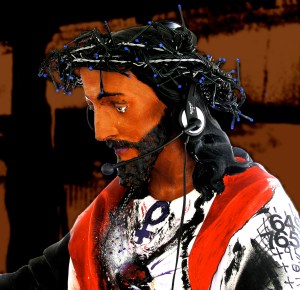
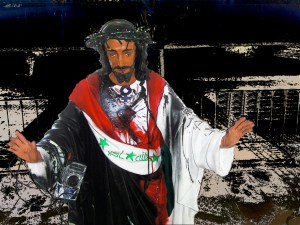
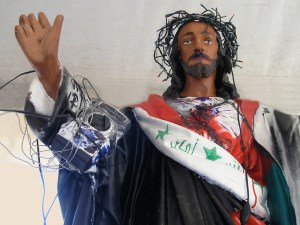
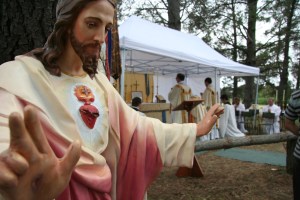
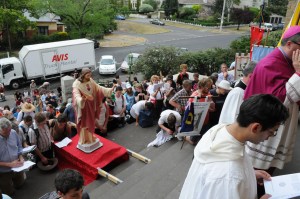
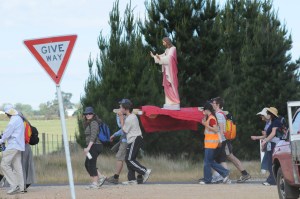
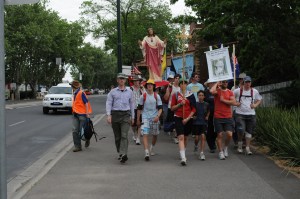
An installation artist is disappointed a group of traditional Catholics bought his sculpture of Jesus portrayed as an Iraqi resistance fighter, repainted it and said prayers to pay for the insult.
Traditional Catholic, Ronan Reilly, 17, explained: “The image of the Sacred Heart is sacred to us, and we believe Jesus is God, so it’s not fitting that Jesus is displayed as an Iraqi terrorist. For these reasons we repainted the statue and made reparation for what was done.”
Matthew Rochford, a Marxist and former Catholic, said he was “disappointed”. “Why did they view my work as such an obscenity that they needed to buy and destroy it? I’m sad it doesn’t exist any more.”
“Their Jesus is pale and boring. I can’t believe they painted over my dynamic and exciting Jesus.”
The sculpture was one of 33 lifesize fibreglass statues of the Sacred Heart of Jesus which were commissioned by World Youth Day organisers for an outdoor exhibition. Organisers chose artists to create works that would encourage “an interactive dialogue”. The sculptures were later auctioned, with proceeds going to Father Chris Riley’s Youth Off The Streets.
The Catholics raised $2200 and had 20 people praying at St Mary’s Cathedral while the auctions were happening, Mr Reilly said.
“We were able to purchase two – the Iraqi one for $1200 and another one that was covered in tree sap for $1000 – and restored them.”
Mr Rochford’s sculpture had been set up at the Darling Harbour Convention Centre and was wired with flickering LED lights and a battery-powered radio that played white noise.
The flag was a combination of the Iraq, Aboriginal, Afghan and Palestinian flags and it had a women’s rights symbol painted on the heart. “My Jesus was cool,” Mr Rochford said, “a fighter for the Iraqi resistance said for people in occupied lands who have no option but to resist oppressors, for Aboriginal people, women and eccentric hot-pink nailpolish-wearing people who reject gender binaries and like to cross-dress.”
Mr Reilly said that some of the Jesus Walks sculptures had “alarmed many Catholics”. “The image of the Sacred Heart was called a ‘blank canvas’.” He said this overlooked the context of the original image, which represents when Jesus appeared as an apparition to a 17-Century French nun, Sr Margaret Mary, and said: “This is the heart which has loved men so much and gets little love in return.’’
The statue is now in a Church piety store when it’s not being used at Catholic processions and events.
Mr Rochford said: “It’s sad that anything a little provocative or deviant must be wrong. Jesus challenged the status quo, while these people are just returning to blind respect for tradition.”
He said the Jesus Walks exhibition was “one of the few events of World Youth Day that challenged people”. “No one should have a monopoly on the image of Jesus. There’s enough conservatism and traditionalism in society already. Why go back?”
I’ve been putting on blue eyeshadow and blonde wigs since Mamma Mia hit No.1 in 1975. The only time I’d seen the group was as distant, pre-giant-video-screen miniatures onstage during their 1977 Australian tour. And now Benny (the One with the Beard) and Bjorn (the Frog-Faced One) were premiering their new musical, Kristina Fran Duvemala, in a Swedish country town, Malmo. I was hoping for a glimpse of my idols, but all the tickets had been booked out six months earlier.
Friday: Left Stockholm and did the seven-hour train trip to Malmo with another Aussie fan, Sandra. We loitered outside the theatre and asked about tickets. A blonde told us Benny and Bjorn would not be making a grand entrance.
Saturday: Went back to the theatre at 3:30pm. The show was due to start at 6pm. There were about 50 European fans there and also TV reporters, who interviewed us. A feather-boa-draped Swedish journalist hauled us over to the press desk and outlined our dilemma. We were given two tickets to the premiere.
The evening’s highlight was when the rarely-seen Agnetha arrived at 5:30pm. I asked for her autograph, but she brushed me away. I ran after her, but the media pack encircled, squealing, and I was trampled. Sandra was sobbing in a corner somewhere. Frida never turned up – she was in Washington gallivanting with Queen Silvia of Sweden.
The show was sung in Swedish, so I can’t tell you what happened, but there were hundreds of peasants, marriages, deaths, births, and Kristina often looking concerned and clutching a quilt. Anyway, we were mainly trying to look at Bjorn and Benny’s reactions. Agnetha was sitting upstairs.
During the interval, Bjorn and Benny vanished. On a whim, I walked back into the theatre alone, and bumped into Agnetha. I asked for her autograph, but she said, “I can’t – I have to go to the loo!” I was stunned. After 20 years of adoration, listening to her obscure Swedish solo albums. And that was it. “I have to go to the loo.” Just before she walked away (surrounded by several women friends), she turned and paused so I could take a photo.
When the show finished, after the standing ovation, Sandra and I rushed to the backstage doors, but we missed Bjorn and Benny’s departure. After a quick meal at McDonald’s, we went to the after-show party, but Bjorn had left.
We could see Benny playing Swedish folk music on an accordion. A couple of the show’s stars performed songs from the musical. Then endless Dean Martin and Frank Sinatra hits were played. Bundles of early-edition newspapers headlined “Agnetha steals the show” arrived, but remained unopened.
I chatted to Benny as he was leaving and signing autographs at 1:15am and said “I’ll be back!” Then the other fans left, but Sandra and I stayed, numb and frozen. Sandra wanted to leave, as it was raining, but I reminded her we’d waited backstage in Australia until 3am for Bjorn Again! At 2:45am, Benny returned. “Hey, the girls from Perth and Sydney,” he said, correctly remembering our details. As Sandra took photos, she asked: “Do you think we’re crazy?” He smiled and said: “No, I don’t think you’re crazy.” It was 3am and we were freezing in a remote town in the middle of nowhere and we’d travelled so far just for that night, without tickets. I realised that out of the 150,000 fans who’d seen ABBA perform at the Perth Entertainment Centre in 1977, I was the only one who’d tracked them down that night in Malmo.
Sandra asked again, nervously: “Do you think we’re mad?” He paused. “No,” he said, shaking his head, and as he headed for the performers’ mini-bus, he called out: “Have a safe trip home!”