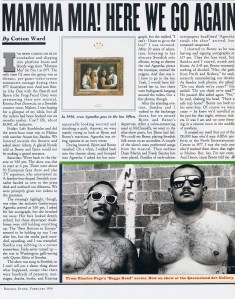
Encounter with ABBA members in Sweden

My article in Rolling Stone.
Rolling Stone, February 1996.

MAMMA MIA! HERE WE GO AGAIN (Rolling Stone)

By Cotton Ward

I’ve been putting on blue eyeshadow and blonde wigs since Mamma Mia hit No.1 in 1975. The only time I’d seen the group was as distant, pre-giant-video-screen miniatures onstage during their 1977 Australian tour. And now Benny (the One with the Beard) and Bjorn (the Frog-Faced One) were premiering their new musical, Kristina Fran Duvemala, in a Swedish country town, Malmo. I was hoping for a glimpse of my idols, but all the tickets had been booked out six months earlier.

Friday: Left Stockholm and did the seven-hour train trip to Malmo with another Aussie fan, Sandra. We loitered outside the theatre and asked about tickets. A blonde told us Benny and Bjorn would not be making a grand entrance.

Saturday: Went back to the theatre at 3:30pm. The show was due to start at 6pm. There were about 50 European fans there and also TV reporters, who interviewed us. A feather-boa-draped Swedish journalist hauled us over to the press desk and outlined our dilemma. We were given two tickets to the premiere.

The evening’s highlight was when the rarely-seen Agnetha arrived at 5:30pm. I asked for her autograph, but she brushed me away.  I ran after her, but the media pack encircled, squealing, and I was trampled. Sandra was sobbing in a corner somewhere. Frida never turned up – she was in Washington gallivanting with Queen Silvia of Sweden.

The show was sung in Swedish, so I can’t tell you what happened, but there were hundreds of peasants, marriages, deaths, births, and Kristina often looking concerned and clutching a quilt. Anyway, we were mainly trying to look at Bjorn and Benny’s reactions. Agnetha was sitting upstairs.

During the interval, Bjorn and Benny vanished. On a whim, I walked back into the theatre alone, and bumped into Agnetha. I asked for her autograph, but she said, “I can’t – I have to go to the loo!” I was stunned. After 20 years of adoration, listening to her obscure Swedish solo albums. And that was it. “I have to go to the loo.” Just before she walked away (surrounded by several women friends), she turned and paused so I could take a photo.

When the show finished, after the standing ovation, Sandra and I rushed to the backstage doors, but we missed Bjorn and Benny’s departure. After a quick meal at McDonald’s, we went to the after-show party, but Bjorn had left.

We could see Benny playing Swedish folk music on an accordion. A couple of the show’s stars performed songs from the musical. Then endless Dean Martin and Frank Sinatra hits were played. Bundles of early-edition newspapers headlined “Agnetha steals the show” arrived, but remained unopened.

I chatted to Benny as he was leaving and signing autographs at 1:15am and said “I’ll be back!” Then the other fans left, but Sandra and I stayed, numb and frozen. Sandra wanted to leave, as it was raining, but I reminded her we’d waited backstage in Australia until 3am for Bjorn Again! At 2:45am, Benny returned. “Hey, the girls from Perth and Sydney,” he said, correctly remembering our details. As Sandra took photos, she asked: “Do you think we’re crazy?” He smiled and said: “No, I don’t think you’re crazy.” It was 3am and we were freezing in a remote town in the middle of nowhere and we’d travelled so far just for that night, without tickets. I realised that out of the 150,000 fans who’d seen ABBA perform at the Perth Entertainment Centre in 1977, I was the only one who’d tracked them down that night in Malmo.

Sandra asked again, nervously: “Do you think we’re mad?” He paused. “No,” he said, shaking his head, and as he headed for the performers’ mini-bus, he called out: “Have a safe trip home!”

Family flees burning house in dead of night

A piercing fire alarm didn’t just startle a Broken Hill family – it saved their lives, writes Cotton Ward.
It was 5.46am on a hot Wednesday last month in Broken Hill when Nathan Brown was woken by five smoke alarms shrieking as the house filled with smoke coming from flaming ducted air-conditioning vents.
He shared the partly renovated tin home with his fiancee, Sheree Battams, and their two children, Memphis, 5, and Alexander, 3.
“Sheree grabbed the kids and the phone and ran out of the house,” Brown says. “We couldn’t see much through the smoke.”
He says it took about a minute to get everyone outside.
Brown decided to rush back in to retrieve a prepared “emergency box” containing birth certificates and the umbilical clamps from their babies.
“When I went back, I saw flames coming through the plastic vents – they were melting,” he says.
When they had assembled outside, Battams rang 000.
“Then it suddenly hit us – ‘Oh no, the cats!”‘ Brown says. Their indoor pets, Lester and Domain, were missing.
It was too dangerous to go back again but Lester was later found alive underneath a bed and Domain had fled outside, hiding in an abandoned dog’s kennel.
“We were very happy we’d all got out alive,” Brown says.
The fireys arrived quickly. “The roof was gone within five minutes. It was irreparable. It took about 15 minutes to extinguish the flames,” Brown says.
A fire investigation showed the blaze was started by a faulty air-conditioning unit.
“Our air-conditioning unit was only three months old – it cost $3500.
“The living room and three bedrooms were burnt. The kitchen, laundry and bathroom didn’t have air-conditioning ducts – they have water and smoke damage.”
They’d just put in an $8000 kitchen and paid $4000 for electrical and plumbing work.
“The house looks OK from the outside,” Brown says, “though if you look closely, you can see the tin is charred.”
A building and engineering report by the insurer, NRMA, deemed the building unsafe and the family is now living nearby with Battam’s mother.
Brown, a butcher, has lived in Broken Hill for five years.
He says the area gets very dry heat, which hits up to 45 degrees. “I’ll get an air-conditioning unit that sits on the side of the wall next time.”
His son’s room had sustained the most damage. “I was looking at Alexander’s room afterwards,” Brown says, then pauses. “Thank God for smoke alarms.”

What you need to know about smoke alarms
* Smoke from home fires is toxic and when you’re asleep, the smoke will put you into a deeper sleep. This is why alarms are critical.
* Smoke alarms should be tested regularly.
* Replace the batteries once a year.
* Vacuum the alarms every six months to keep them clean.

Caption:
TWO PHOTOS: Everyday heroes … (at front) fire survivors Sheree Battams, with son Alexander, 3, and Nathan Brown with Memphis, 5, flanked by firefighters (from left) Wayne Reed, Nathan Pascoe, Glen Whitehead and Ian Sanderson. Photo: Darrin Manuel; PHOTO: Life saver … every home needs one.

Alert and aware

Boyd Thompson, 84, and his wife Joan, 79, have lived at Braeside Close retirement village, Wollongong, for five years and always attend the annual fire-safety talk and drill.
Boyd says that in their 58 years of marriage, they have had to “use a fire blanket a couple of times” to put out a cooking fire on the stove. “The fire blanket was made of fibreglass – never wash them, they fall to pieces,” Boyd says. “You always have to get a new one.”
He said a nearby elderly lady had accidentally set her microwave to 20 minutes instead of 20 seconds, which had caused a small fire.
“Gosh, when I opened the door there was smoke billowing everywhere. We have fireproof doors but the smoke builds up from pressure and expands when it gets through the cracks.”
The village of 50 units with 66 tenants is run by the Illawarra Retirement Trust and once a year its fire information officer gives a talk.
“He brings along a flame and we practise using a fire blanket and learning how to put it out without burning our hands.”
Boyd says the officer emphasises the necessity of cleaning filters above stoves and in clothes dryers because lint can catch fire.
They are also warned to be careful when using extension cords.
“We don’t run cables across the floor because we’re old people – we don’t want to trip over. Some people use extension cords and run them around the walls and under curtains. The cords can overheat and set the curtains alight,” he says.
They have also been told not to use cheap nightlights, which can cause fires.

Boyd says he and his wife do a practice drill once a year of exiting from the bedroom to the front door, imagining there is dim lighting and blinding smoke.
They have directions of what to do when a fire occurs and the location of a designated meeting spot written on an A4 sheet on bright yellow paper, in large print, by the front door.
“It says to RACE – Residents get out; raise the Alarm; Contain the fire by closing doors and windows and Evacuate. We have three exits from our home,” Boyd says.

Book reviews: Sun-Herald

Creating Magic
Lee Cockerell
(Random House, $32.95)
Cockerell worked at Disney for more than a decade, eventually as an executive vice-president of operations. Anyone who has visited a Disney theme park will be amazed at how they keep the level of service so high throughout a full day catering to so many families with young children, high expectations and usually in hot weather. He shares 10 strategies and all the secrets of how, despite having the usual stresses of outsourcing labour, job cuts and restructuring, employees can be trained and motivated to keep the Disney magic alive. Inspirational and comprehensive. CW

Dating Makes You Want To Die
Daniel Holloway and Dorothy Robinson
(HarperCollins, $24.99)
Aimed at the older person who has been suddenly plunged back into the dating scene, this book gives an update on the modern rules of dating, from personal makeovers to proposing, meeting the parents and staying together. It’s good if you feel trepidatious about dating and want an idea of where to set boundaries but overall I felt there were too many rules. If you’re that clueless, you’d be better off reading an etiquette guide. Also, the authors try to be humorous, but this involves derogatory jokes about obese people and an assumption that all single people are “pathetic, unloveable” losers. Boring. CW

Croc
Robert Reid
(Allen and Unwin, $26.95)
Danger, death and destruction are the gist of this book about lethal animals – human and otherwise. It’s divided into four sections: hunters, victims, lucky escapes and crazy capers. I turned straight to the victims section, which avoids repeating cases covered in similar books by focusing on incidents in north Queensland. I then skipped back to the section about croc hunters, which has amazing tales of Crocodile Dundee loners and adventurers being completely insane and taking their chances against large saltwater crocodiles. Definitely a book that will enhance any trip north or for those too scared to go. CW

International masters of online study

WORKING with talented people from around the world and the flexibility of fitting in study across time zones are some of the reasons students enjoy online courses. All that’s needed is a computer, digital camera and scanner.
At Southern Cross University, a new graduate certificate of recruitment, placement and career development is a distance-education course for people in the employment services and recruitment industry.
Course co-ordinator and lecturer Ros Cameron says Blackboard and Illuminate software are provided by the university. Most communication is done in the Blackboard forum, which includes videos, and assignments are submitted online. Students need to spend five to 10 hours a week studying.
The University of NSW’s College of Fine Arts has been running a fully online master of cross-disciplinary art and design coursework degree for the past 18 months.
Postgraduate course co-ordinator and lecturer Simon McIntyre says the students, aged from 23 to 65, are in locations such as Singapore, Hong Kong, China, the US, Philippines and the United Arab Emirates.
“We have students in outback Australia who only have access to a shared dial-up internet account.”
Lectures are delivered as text and images, videos or podcasts. After lectures, students come together in an online message board to discuss ideas.
Interactive media and design teacher Andy Polaine is in Germany and has been teaching online since 1999. “Face-to-face classes usually suffer from a few dominant personalities, time pressure and being too full. Online class interaction is much more active and engaged,” he says.
“Online students and teachers can take time to think about what they want to say, disagree and debate with more confidence because they don’t have the face-to-face confrontation.”
He says online teaching usually emphasises a collaborative process. “Conversations are automatically archived, so when someone says something brilliant in a particular thread, everyone can go back and refer to it.”
Polaine says a downside is that the life on campus dies out but the weakening of the students’ union through the abolition of compulsory fees has helped that process anyway.
“Universities need to rethink what the physical campus is about and I believe it’s about creating flexible, social and collaborative spaces to meet and work. Otherwise there’s not much point in leaving the comfort of your computer and home.”
Student Lianna Wittenberg, who lives in Singapore, started studying in March. “The interaction can be fast paced or slow. It is interesting in the way the written word can be taken. There have been instances where I have read something, taken offence to it and later realised it may have been written in a different tone,” she says.
“I have found the experience quite a roller-coaster ride. I am often rushing back to the message board to see if anyone responded to my comments. My friends joke that the online course is the new Facebook as I am always on it and checking who said what.”
She describes the convenience as “excellent”. “With time differences, job and social commitments, I can still manage to work online and achieve some great results.”