Brilliant article by Ross Gittins about how democracies can work best. Which is why newspapers are best because they give space for analysis. Radio lifts the newspapers’ hard work and discuss it. Free. At least it’s being discussed further.
Then commercial news bulletins often get off-track with spin.
Category: Writing

NSW public transport
I hate how it takes a full hour to travel only 3km in Sydney to get to my workplace in Pyrmont.
The parking is hugely expensive too – $20/day at Star City Casino.
The State Govt should get its act together on public transport before it discourages cars. We’re all time poor so who can spend an hour to travel 3km?
This problem could be fixed by a bus running down King St Newtown directly to Pyrmont.
The Inner West line to the City is also stuffed – there’s a 20-minute wait between trains at peak hour! Incredible.
You’re not even allowed to drive electric bicycles either – which is insane considering how hilly Sydney is.
Share this:
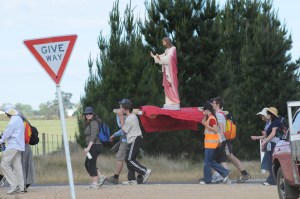
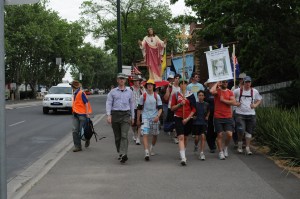
How great Thou art: Jesus statue ‘desecrated’
An installation artist is disappointed a group of traditional Catholics bought his sculpture of Jesus portrayed as an Iraqi resistance fighter, repainted it and said prayers to pay for the insult.
Traditional Catholic, Ronan Reilly, 17, explained: “The image of the Sacred Heart is sacred to us, and we believe Jesus is God, so it’s not fitting that Jesus is displayed as an Iraqi terrorist. For these reasons we repainted the statue and made reparation for what was done.”
Matthew Rochford, a Marxist and former Catholic, said he was “disappointed”. “Why did they view my work as such an obscenity that they needed to buy and destroy it? I’m sad it doesn’t exist any more.”
“Their Jesus is pale and boring. I can’t believe they painted over my dynamic and exciting Jesus.”
The sculpture was one of 33 lifesize fibreglass statues of the Sacred Heart of Jesus which were commissioned by World Youth Day organisers for an outdoor exhibition. Organisers chose artists to create works that would encourage “an interactive dialogue”. The sculptures were later auctioned, with proceeds going to Father Chris Riley’s Youth Off The Streets.
The Catholics raised $2200 and had 20 people praying at St Mary’s Cathedral while the auctions were happening, Mr Reilly said.
“We were able to purchase two – the Iraqi one for $1200 and another one that was covered in tree sap for $1000 – and restored them.”
Mr Rochford’s sculpture had been set up at the Darling Harbour Convention Centre and was wired with flickering LED lights and a battery-powered radio that played white noise.
The flag was a combination of the Iraq, Aboriginal, Afghan and Palestinian flags and it had a women’s rights symbol painted on the heart. “My Jesus was cool,” Mr Rochford said, “a fighter for the Iraqi resistance said for people in occupied lands who have no option but to resist oppressors, for Aboriginal people, women and eccentric hot-pink nailpolish-wearing people who reject gender binaries and like to cross-dress.”
Mr Reilly said that some of the Jesus Walks sculptures had “alarmed many Catholics”. “The image of the Sacred Heart was called a ‘blank canvas’.” He said this overlooked the context of the original image, which represents when Jesus appeared as an apparition to a 17-Century French nun, Sr Margaret Mary, and said: “This is the heart which has loved men so much and gets little love in return.’’
The statue is now in a Church piety store when it’s not being used at Catholic processions and events.
Mr Rochford said: “It’s sad that anything a little provocative or deviant must be wrong. Jesus challenged the status quo, while these people are just returning to blind respect for tradition.”
He said the Jesus Walks exhibition was “one of the few events of World Youth Day that challenged people”. “No one should have a monopoly on the image of Jesus. There’s enough conservatism and traditionalism in society already. Why go back?”




Share this:

Family flees burning house in dead of night
| A piercing fire alarm didn’t just startle a Broken Hill family – it saved their lives, writes Cotton Ward. It was 5.46am on a hot Wednesday last month in Broken Hill when Nathan Brown was woken by five smoke alarms shrieking as the house filled with smoke coming from flaming ducted air-conditioning vents. He shared the partly renovated tin home with his fiancee, Sheree Battams, and their two children, Memphis, 5, and Alexander, 3. “Sheree grabbed the kids and the phone and ran out of the house,” Brown says. “We couldn’t see much through the smoke.” He says it took about a minute to get everyone outside. Brown decided to rush back in to retrieve a prepared “emergency box” containing birth certificates and the umbilical clamps from their babies. “When I went back, I saw flames coming through the plastic vents – they were melting,” he says. When they had assembled outside, Battams rang 000. “Then it suddenly hit us – ‘Oh no, the cats!”‘ Brown says. Their indoor pets, Lester and Domain, were missing. It was too dangerous to go back again but Lester was later found alive underneath a bed and Domain had fled outside, hiding in an abandoned dog’s kennel. “We were very happy we’d all got out alive,” Brown says. The fireys arrived quickly. “The roof was gone within five minutes. It was irreparable. It took about 15 minutes to extinguish the flames,” Brown says. A fire investigation showed the blaze was started by a faulty air-conditioning unit. “Our air-conditioning unit was only three months old – it cost $3500. “The living room and three bedrooms were burnt. The kitchen, laundry and bathroom didn’t have air-conditioning ducts – they have water and smoke damage.” They’d just put in an $8000 kitchen and paid $4000 for electrical and plumbing work. “The house looks OK from the outside,” Brown says, “though if you look closely, you can see the tin is charred.” A building and engineering report by the insurer, NRMA, deemed the building unsafe and the family is now living nearby with Battam’s mother. Brown, a butcher, has lived in Broken Hill for five years. He says the area gets very dry heat, which hits up to 45 degrees. “I’ll get an air-conditioning unit that sits on the side of the wall next time.” His son’s room had sustained the most damage. “I was looking at Alexander’s room afterwards,” Brown says, then pauses. “Thank God for smoke alarms.” What you need to know about smoke alarms |
| Caption: |
| TWO PHOTOS: Everyday heroes … (at front) fire survivors Sheree Battams, with son Alexander, 3, and Nathan Brown with Memphis, 5, flanked by firefighters (from left) Wayne Reed, Nathan Pascoe, Glen Whitehead and Ian Sanderson. Photo: Darrin Manuel; PHOTO: Life saver … every home needs one. |
Share this:
Alert and aware
Boyd Thompson, 84, and his wife Joan, 79, have lived at Braeside Close retirement village, Wollongong, for five years and always attend the annual fire-safety talk and drill.
Boyd says that in their 58 years of marriage, they have had to “use a fire blanket a couple of times” to put out a cooking fire on the stove. “The fire blanket was made of fibreglass – never wash them, they fall to pieces,” Boyd says. “You always have to get a new one.”
He said a nearby elderly lady had accidentally set her microwave to 20 minutes instead of 20 seconds, which had caused a small fire.
“Gosh, when I opened the door there was smoke billowing everywhere. We have fireproof doors but the smoke builds up from pressure and expands when it gets through the cracks.”
The village of 50 units with 66 tenants is run by the Illawarra Retirement Trust and once a year its fire information officer gives a talk.
“He brings along a flame and we practise using a fire blanket and learning how to put it out without burning our hands.”
Boyd says the officer emphasises the necessity of cleaning filters above stoves and in clothes dryers because lint can catch fire.
They are also warned to be careful when using extension cords.
“We don’t run cables across the floor because we’re old people – we don’t want to trip over. Some people use extension cords and run them around the walls and under curtains. The cords can overheat and set the curtains alight,” he says.
They have also been told not to use cheap nightlights, which can cause fires.
Boyd says he and his wife do a practice drill once a year of exiting from the bedroom to the front door, imagining there is dim lighting and blinding smoke.
They have directions of what to do when a fire occurs and the location of a designated meeting spot written on an A4 sheet on bright yellow paper, in large print, by the front door.
“It says to RACE – Residents get out; raise the Alarm; Contain the fire by closing doors and windows and Evacuate. We have three exits from our home,” Boyd says.
 Cotton Ward