Have held a couple of If You Are The One fests at mine. I’d watch a zillion episodes and edited them down savagely and we’d watch from 1pm to 7pm. So many heart-wrenching emotions!
About 7 guests turn up and we order tummy-filling Chinese food from Happy Chef.
I’d selected bits that reflected Chinese culture. So we got lots of zany stuff about not dating Westerners, choosing people on the basis of single or double eyelids, preferences for Asian women with fair skin (even to the point of the guy insisting the woman play sport at nighttime so she didn’t get a tan), comments on Westerners’ “three-dimensional” faces, their thoughts on the “one child policy” and the dating trials faced by female PhD students (any woman who studies too much finds it harder to get a date). Le Jia said Westerners would be arrested by making such racial distinctions, if saying that in America.
I like all their philosophical wisdom: Le Jia said to a young man: “You pay an unnecessary price for being too sharp.” Meng Fei: “When you get to a certain age, you’ll put on weight even if you drink water!” Everything Huang Han says is brilliant, especially about Aristotle: she’s very good at arguing the finer points with arrogant candidates.
Regarding the one-child policy, Le Jia and Meng Fei pointed out that couples didn’t need to have children, they could “devote their time to serving others and socialism”. Or they might want to “give love to children who don’t have parental love.” Huang Han says having a child shouldn’t be a filial duty, but should be done because the couple wants to have a child.
In Chinese society, it seems the most desirable traits are that women are pure and simple and men are sunny and carefree.
B made delicious coconut and lime cake, Ant brought Singapore orchids, Kris brought fortune cookies, and I provided Lychee tea, pork buns and shrimp and meat-flavoured crisps (recommended by Asian bloke at Asian supermarket).
I will be holding another IYATO fest for a special person who missed out, being overseas at the moment.
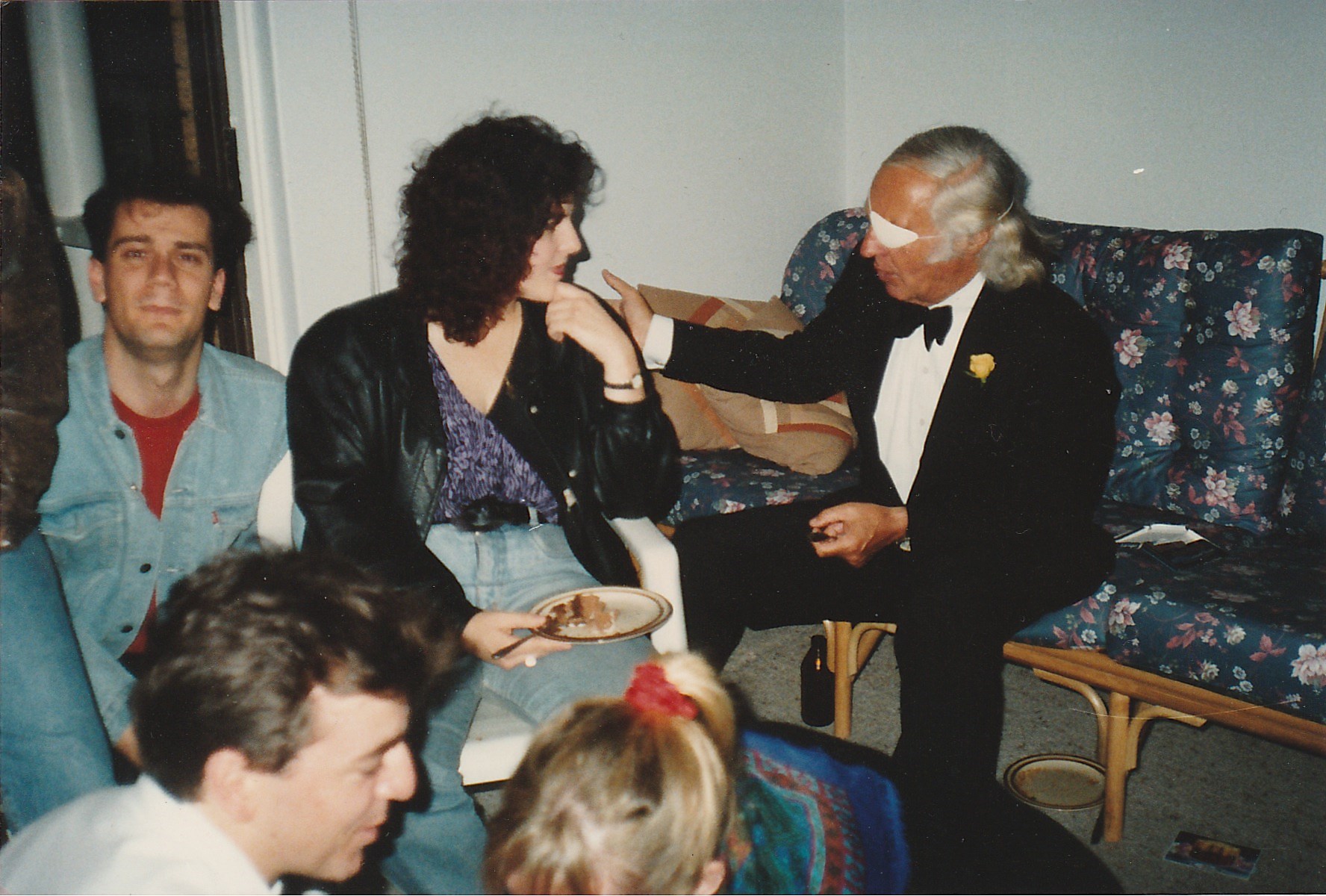
Cotton Ward and Bill Ranken 1992, housewarming party at Bondi flat.
Whenever four of us former Eastern Express staff get together every year or so for the past 30yrs, we always toast the inimitable Bill Ranken “who’ll outlive all of us!” we predicted. He was such a ball of positive and energy with an endless work ethic directed towards socialising. We’d worked with him 1990-93 when he reinvented himself as a Society Spy social writer as a “youthful” 60-year-old.
Bill Ranken at my flatwarming in a modest 2-bedder. No party was too small! He loved all of Sydney.
His forte was the relentless drive to go out, and everything was devoted to that aim. All we knew at the time was that he lived in a little studio flat, and used to jog every morning to keep trim. He was fitter than all of us and we were in our early 30s! He knew all the socialites by their first names, and was very discreet. I’d have to try and interpret his laughter to my questions to get any gossip.
Bill’s sometime social photographer, John Paoloni, me and Bill Ranken. At housewarming party.
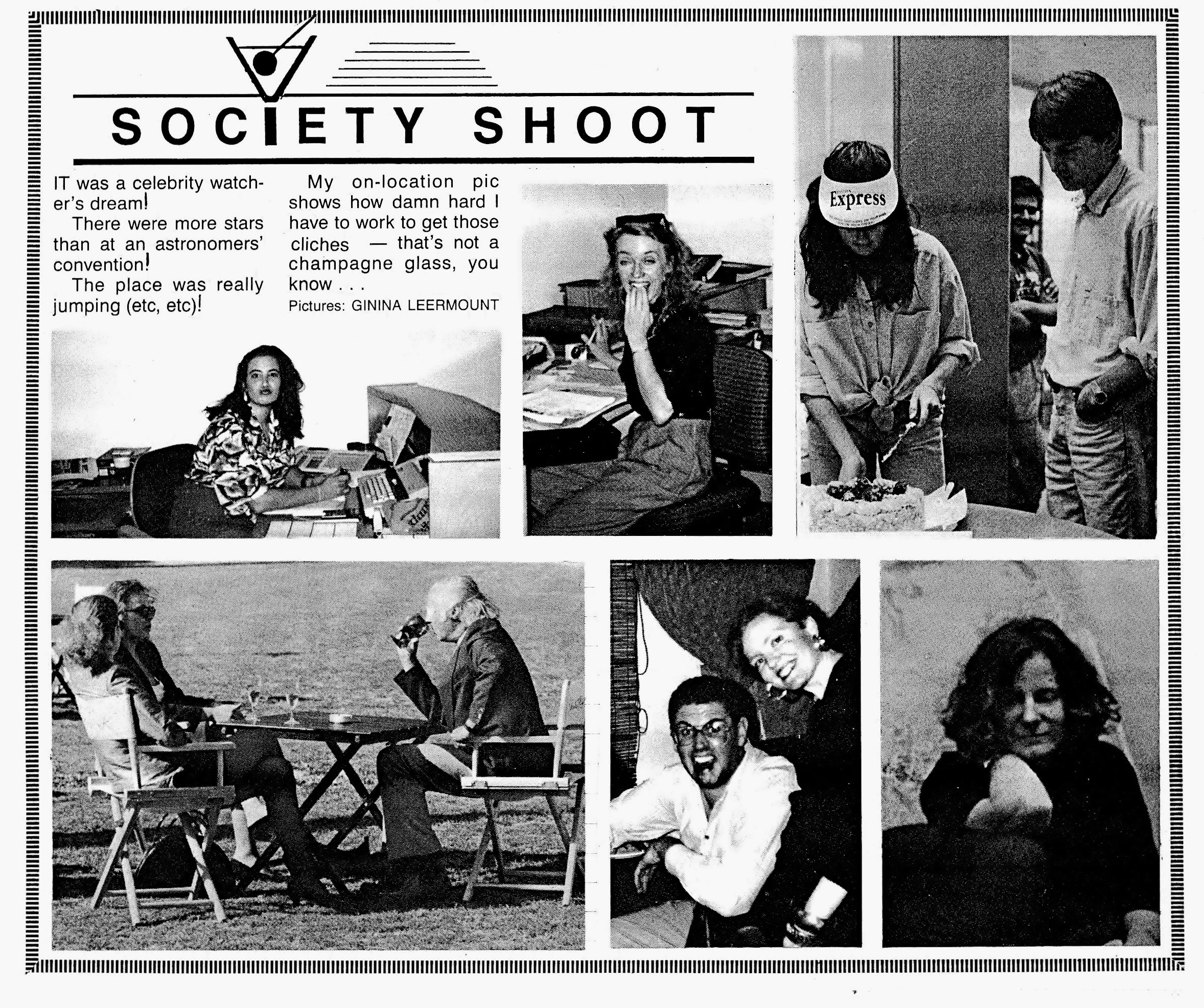
We trained him in the gig: he had a photographer and wrote names in his notebook. Early on, he often lost his notebooks but soon realised the importance of getting all the names, or we wouldn’t use the photos. His opening sentences were always a bright splash of hyperbole: “There were more stars than in the galaxy …”
I subbed and laid out his social spreads for 4.5 years until the paper folded, and it was always a joy when he visited the office. He couldn’t really write, but he persevered in this profession anyway, knowing that taking photos and mingling were his strong points.
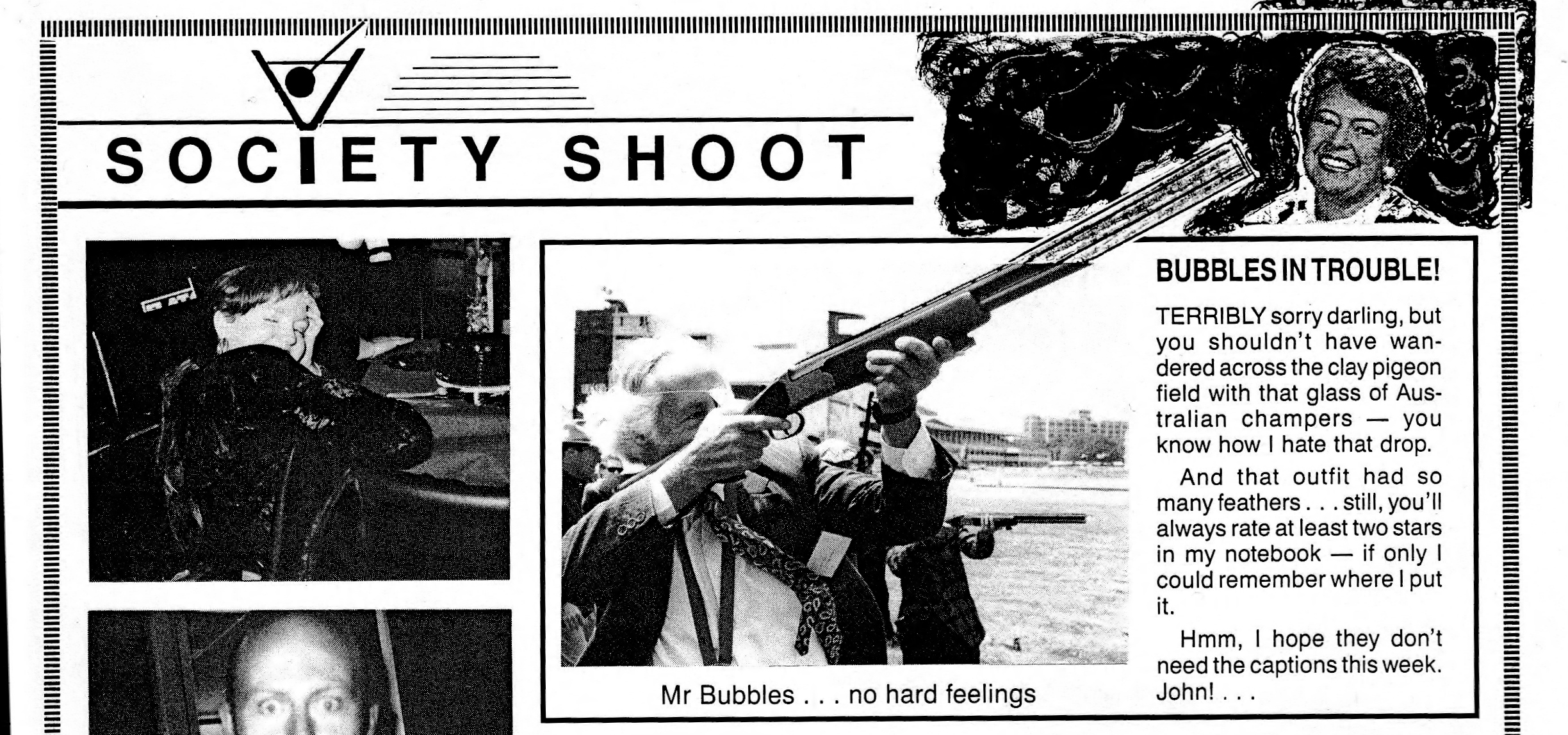
One of three parodies I wrote of Bill’s Society Spy page for the Eastern Express Christmas mag.
He was always gracious. I was in my “punk” phase at the time, holding a “Flatmate from Hell” flatwarming party in Bondi and, of course, Bill said: “I’ll be there!” He came along on a Saturday night in his trademark suit and bow tie, his daily free rose from Carla Florist, Double Bay, in his lapel, and was his usual buoyant self, working the room.
As he got older, our admiration only increased, as it would be harder to fit into those young social circles and we knew he’d alienated some people with his shenanigans. But he was still up at the crack of dawn every day, jogging away, as tanned as ever, and out on the town every night: he just loved people, and helped out at the Wayside Chapel. He was an inspiring story of accepting who he was, his limitations, but still giving life everything he had, every day til he dropped.
One of three parodies of his Society Spy section I wrote for an Eastern Express Christmas mag.
Last time I bumped into him was on Oxford St, outside the Beauchamp Hotel, where he was bending down to tie his shoelace, then checking in a mirror to see he was looking polished. I said hi and he was as friendly as ever.
Now that he’s passed on, we see his back-story and it makes his humble choices even more amazing. He was worth $30million when he died, tied up in family land, which, though he was the eldest son, he encouraged other family members to take on. He would mention how he lost his eye and during the recuperation time he realised he wasn’t suited to the farming life.
More tragedies: his younger brother who took over the property died, and then his sister’s husband who took over was killed too. A year after this last death, Bill arrived at the Eastern Express, while going back and forth to help on the property as much as he could. He had a big heart. You can read elsewhere how he’d been a consort to Princess Margaret and a playboy in his younger years: but later, when he had no money to show, he still went out diligently, as he loved people and loved Sydney.
Fittingly, his last published words: “I’ve had a wonderful time. To the socialites of the eastern suburbs, I insist they all keep hosting fabulous parties.”
This song sums up Bill for me: formal, a bit dorky, wholesome in his own way, ever-cheerful and sunny, add a dollop of old fashioned kindness. Oh, Darling, and Anything Goes!
And Music To Watch Girls By
One Thing – Bill stuck to the one thing he loved, socialising.
(While some reports say all Bill’s photos and work were lost, this is not true! Four years of his work, 1990 to Oct 1993, are held on microfiche by the NSW State Library.)
About 2.1 billion people are affected by the obesity epidemic and rates are soaring, says a recent study by the McKinsey Global Institute (MGI).
This is 30 per cent of the global population, and nearly two-and-a-half times the 840 million people who don’t have enough to eat.
The institute’s study focuses on the worldwide economic costs of obesity, which have risen to US$2 trillion annually. This is the same monetary impact as armed conflict, and slightly less than the costs incurred by smoking.
It is about 2.8 per cent of economic activity worldwide, which adds up to 2 to 7 per cent of the health care budget in developed countries.
But only 0.25 per cent of the total cost of obesity is used for prevention strategies, while the rest is used for dealing with the consequences.
The report’s estimate of the economic toll from obesity includes lost productivity (nearly 70 per cent of the total costs), health care usage, and the investment needed to combat obesity.
Obesity in North Africa, Latin America, and the Middle East are at the same level as Europe, and the problem is becoming steadily more prevalent in South Asia and East Asia.
Australia’s getting bigger
Australia’s obesity rates are increasing faster than the rest of the world with a quarter of our children being overweight. The Australian Heart Foundation says more than a third of Australian adults are overweight.
Compared to non-indigenous people, Aboriginal and Torres Strait Islander women are 1.7 times more likely to be obese and men 1.4 times more likely.
The Federal Government’s Australian National Preventive Health Agency says the economic cost of overweight adults is about $21 billion, plus $35.6 billion in government subsidies.
The agency says the direct and indirect costs of obesity was $37.7 billion and the direct financial cost was $7.7 billion.
National research showed the biggest risk factors for gaining weight are stress (especially financial worries), lack of access to green spaces and healthy food, and poor sleep.
Recommendations
The McKinsey Global Institute warns we cannot wait for conclusive data on the effectiveness of preventative strategies, such as taxing sugar-filled drinks, as there needs to be an “aggressive all-hands-on-deck approach” because the cost of failing is too high.
It suggests successful small-scale experiments should be quickly scaled up to improve public health.
The institute advised that a major shift needs to occur in the way the food business sector advertises its products. It says it’s important that new research is conducted, as losing weight is not easy, particularly for people living in obesogenic environments that encourage unhealthy eating choices and minimise the opportunities for exercise.
It predicts that if we do not find solutions, almost half the adult world will be overweight or obese by 2030.
Born between 1980 and the early 2000s, Millennials see themselves as being tolerant, curious, positive, sharing, connected, flexible, innovative generation.
By 2025 will make up 75 per cent of the global workforce.
They are true to themselves and are the most-educated generation. In 2011, 52 per cent of young adults (18 to 34 years) had a non-school qualification and 26 per cent held a bachelor degree or higher qualification. Go back 35 years to 1976 and only 30 per cent in the same age group had a non-school qualification and just 5 per cent held a bachelor degree or higher qualification.
Recent events, globalisation and happiness!
With experience of the world that goes back 40 years, the big trends and events that have helped shaped Millennials include the 9/11 terrorist attacks, the launch of Facebook, the dot.com bust, the 2008 global recession and Barack Obama’s election. The Black Saturday bushfires, Global Financial Crisis and Queensland floods weighed heavily on Australian Millennials.
Climate change is the top problem facing society in the next 20 years according to 300 Millennials interviewed in Australia for the Deloitte Millennial Innovation Survey.
Despite the threat of terrorism, natural disasters, economic catastrophes and climate change, 84 per cent of Australian Millennial respondents to the Viacom survey were happy (global average: 87 per cent). Nevertheless, 35 per cent were stressed (global average: 33 per cent).
Opinions on business
The Mind the Gaps Deloitte Millennial survey, which interviewed 7800 Millennials from 29 countries including Australia, showed Millennial respondents thought businesses needed to pay equal attention to people as they do to products and profits.
Seventy-five per cent thought businesses were too fixated on their own agendas and should be more focused on improving society.
The Deloitte Millennial Innovation Survey of 4800 people in 16 “markets” (covering at least 18 countries), provided more information on Australians: 70 per cent thought employee satisfaction was very important (just less than financial performance). Only 58 per cent thought their company helped society in some way or that they worked for an innovative company.
Working with Millennials
Millennials often have a broader perspective about supervisor-subordinate relationships, and want close relationships and frequent feedback from their boss. Their ideal boss is mostly a mentor (50 per cent), leader (40 per cent, confidant (30 per cent) and friend (23 per cent). The four qualities they wanted in a boss were: support (43 per cent), expertise (42 per cent), motivation (39 per cent) and fairness (38 per cent).
Millennials are optimistic and familiar with technology. They may be well placed to provide opinions on how to improve operations and marketing through technology. Like Generation X workers, they feel rewarded by work arrangements that offer more flexibility and new technology.
Myers, K. & Sadaghiani, K., ‘Millennials in the workplace: A communication perspective on Millennials’ organizational relationships and performance’, Journal of Business and Psychology, vol. 25, no. 2, pages 225–238,
http://www.ncbi.nlm.nih.gov/pmc/articles/PMC2868990/
It’s easier to get through a tough day when a photo or video of fluffy animals doing cute things appears on your social media feed.
Pets are big winners in the online viral stakes, sometimes making their owners moolah via corporate sponsorships, product placements and book deals — such as Grumpy Cat and Boo.
Cats are the undisputed champions and an exhibition entitled How cats took over the Internet in NYC’s Museum of the Moving Image analyses the importance of cat-related content.





 About 2.1 billion people are affected by the obesity epidemic and rates are soaring, says a recent study by the McKinsey Global Institute (MGI).
 By 2025 will make up 75 per cent of the global workforce.


